
How Adani Group Is Building Sustainable Ports Infrastructure
How Adani Ports & Special Economic Zone is building sustainable ports with cleaner operations, climate resilience and nature conservation as global trade evolves.
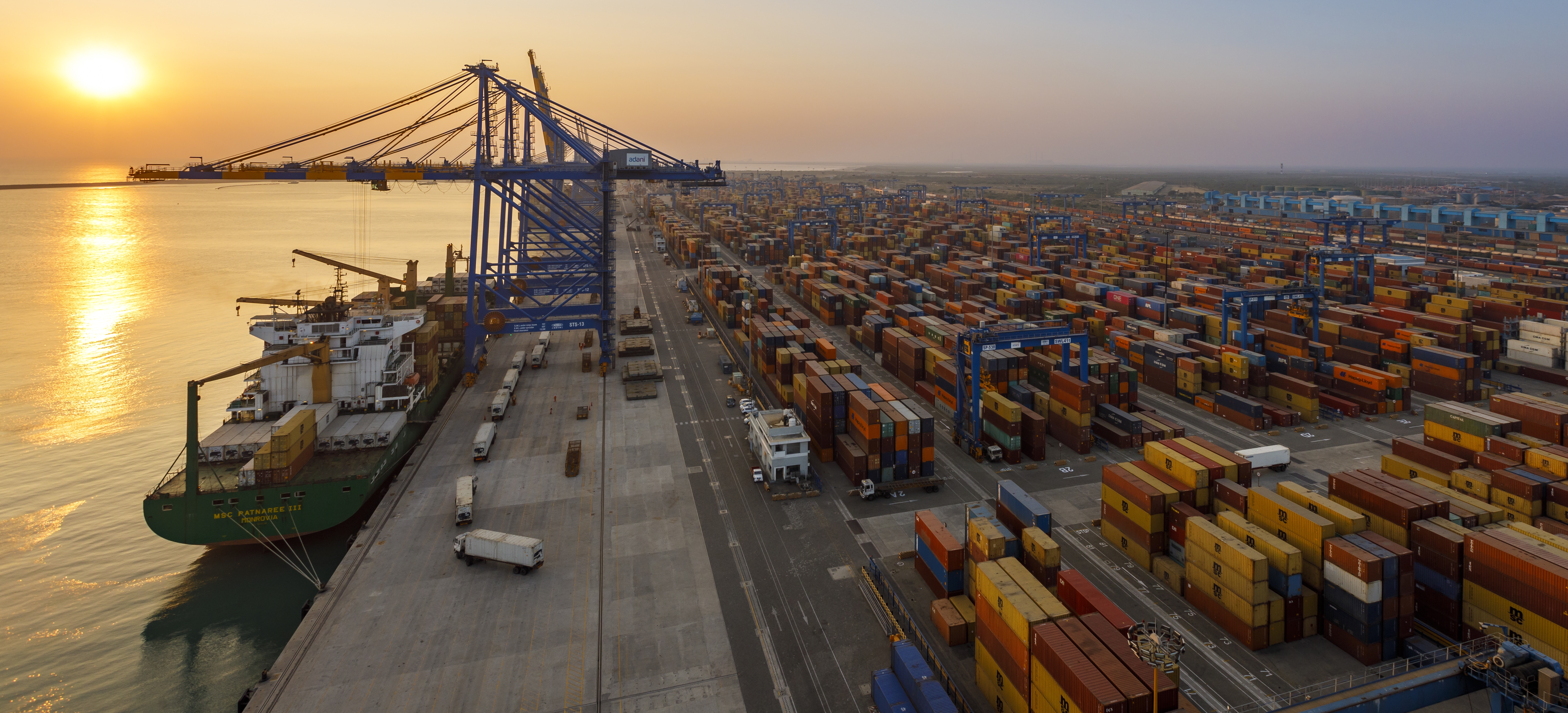
Ports are where global trade meets the physical world. Ships arrive, cargo is moved, trucks and trains carry it onward and supply chains begin their next leg of operations. As the volume of trade grows, the infrastructure supporting it faces a more demanding environment. Extreme weather, rising sea levels and pressure to reduce emissions are changing the way ports are designed and operated.
For Adani Ports and Special Economic Zone (APSEZ), India’s largest integrated transport utility, that means looking at sustainability through the way a port actually works. The company, which has committed to Net Zero emissions by 2040, is expanding renewable energy and electrification and has brought climate risk assessments into its enterprise risk management framework. In the financial year (FY)2025, renewable electricity accounted for 16 per cent of its electricity consumption, while emission intensity fell 12 per cent year on year.
At Hazira in Gujarat, APSEZ has developed India’s first steel slag-based road at a private port. Across its network, 12 ports have achieved Zero Waste to Landfill certification. The changes extend from the equipment operating inside terminals to the natural ecosystems along the coast.
Sustainable ports start with the coastline
A port’s relationship with its surroundings matters when it sits on the coast. Mangroves can reduce erosion, absorb wave energy and provide habitats for marine life. They can also offer a natural buffer against storm surges.
APSEZ has planted 4,240 hectares of mangroves and conserved a further 3,000 hectares. The effort places coastal ecosystems alongside engineered infrastructure when considering the resilience of port assets.
APSEZ has also adopted the Taskforce on Nature-related Financial Disclosures (TNFD), becoming India’s first integrated transport utility to adopt the framework. TNFD looks at a company’s dependencies and impacts on nature, as well as the risks and opportunities that arise from them.
For a port operator, that makes the health of the surrounding coastline relevant to the resilience of the asset itself.
APSEZ’s TNFD Report provides further detail on its approach to nature-related risks and opportunities.
Sustainable ports need cleaner operations
The changes are visible inside terminals too. APSEZ has introduced electric internal transfer vehicles, battery-powered reach stackers and electric empty-container handlers, while cranes and smaller vehicles are also being electrified. The company reported a 29 per cent reduction in emission intensity over five years.
Renewable power is growing alongside electrification. APSEZ had commissioned 277 megawatts (MW) of renewable capacity by FY2025, comprising solar, wind and hybrid capacity, and has set a target of 1,000 MW.
Resource use is being addressed too. During FY2025, APSEZ reused or recycled 42 per cent of its total waste and recovered another 33 per cent. The steel slag road at Hazira is one example of how an industrial by-product can be put to use in port infrastructure.
Its Climate Action Report sets out the company’s wider progress.
Building climate-resilient ports for the long term
Port assets are built to operate for decades. That makes understanding future climate conditions a practical business consideration, not a distant environmental concern.
APSEZ has conducted climate vulnerability assessments across its ports and terminals, using modelling to examine risks including extreme weather and sea-level rise. Climate risks are incorporated into its enterprise risk management framework, while an internal carbon pricing mechanism directs funding towards projects that can improve energy efficiency and reduce emissions.
Climate resilience therefore extends beyond the physical structure of a port. It includes the energy used to run it, the resources it consumes, the ecosystems around it and the decisions made before new infrastructure is built.
For APSEZ, that work is already visible across its network: in electric equipment, renewable power, restored mangroves, waste recovery and the way climate and nature risks are assessed before decisions are made. For an industry built around infrastructure that must operate for decades, those changes are becoming part of what it means to build a port that can keep working as the world around it changes.