
What if your office could make you smarter?
Too often, what a good workplace looks like has depended on assumptions. Companies invest millions in office designs based on trends or best guesses, only to find out too late that they don’t work.But the stakes have never been higher. As AI automates more routine tasks, the edge for organizations lies in elevating inherently human skills, from creativity to emotional intelligence, that rely on peak cognitive performance. That’s why JLL is pioneering a new approach: workplace strategies grounded in how the brain actually works, transforming office spaces into engines of human potential.
JLL research shows that when people experience high psychological stress at work, their cognitive engagement can drop by up to 40%. That means slower problem-solving, weaker decision-making and diminished collaboration—exactly the human capabilities organizations need most. Environments with constant interruptions, disorienting layouts, poor air quality and other poorly considered design features can all contribute to workplace stress.
In high-performance sports, that kind of drop would demand immediate action.
“In Formula 1™ racing, it’s a multibillion-dollar industry applying science to improving fractions of seconds in performance,” says Cynthia Kantor, CEO, Project and Development Services, JLL. “Why can’t that approach be used to help professionals in the workplace?”
JLL is now answering that question with a surprising finding: the right space design doesn’t just support work—it amplifies how well our brains actually function.
The science behind the design
JLL has partnered with University College London (UCL) on a neuroscience study to understand how our environment truly impacts our minds.
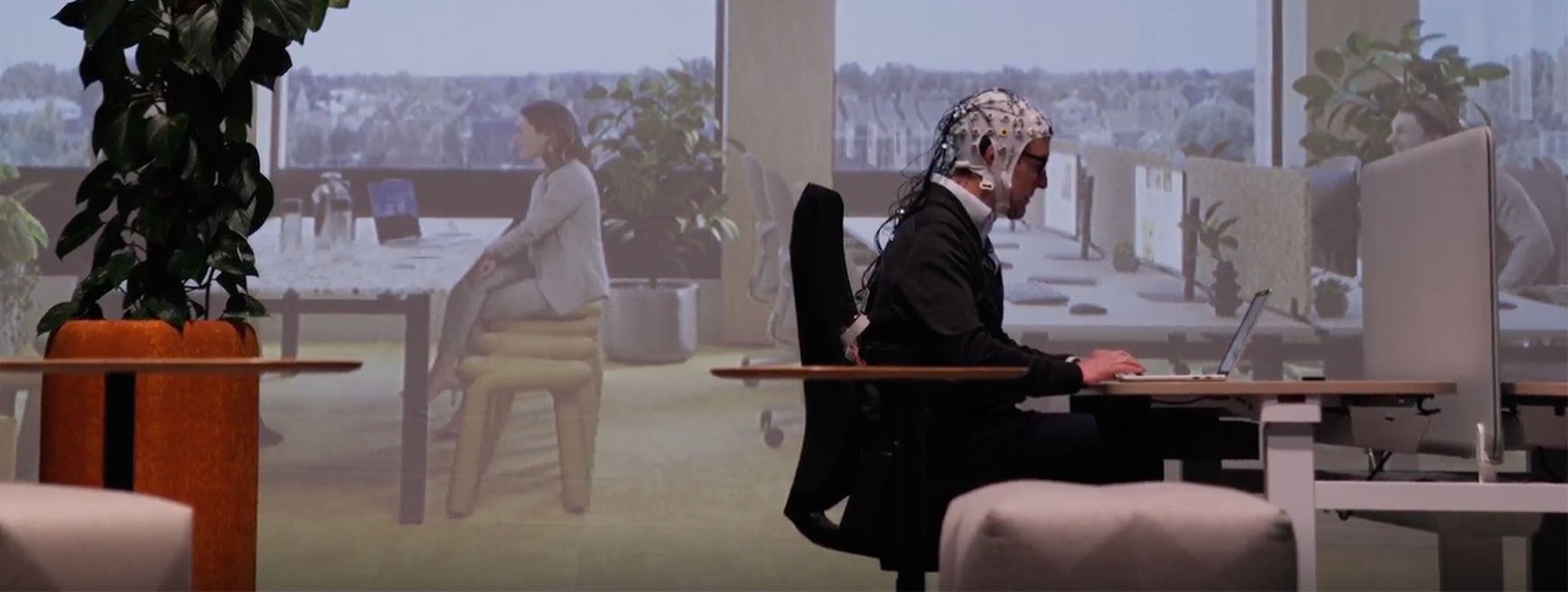
The research takes place at UCL’s Person Environment Activity Research Laboratory (PEARL), a unique facility where complete office environments can be simulated with precision control over every variable, from lighting intensity and sound conditions to spatial layout and air quality.
This level of control is what makes the science possible. PEARL allows researchers to isolate specific design elements and measure their exact effects. “It’s this capacity to recreate the world and then repeat it or vary something slightly, which you just cannot do in real offices,” says Professor Hugo Spiers of UCL’s Faculty of Brain Sciences.
The methodology combines multiple measurement approaches. Using tools like electroencephalography (EEG) to monitor brain activity in real time, participants perform real work tasks while researchers track what distracts them, which features support focus, how different spatial configurations affect stress and how design changes the way people interact.
“It allows us to gauge how people respond to stimulus, as opposed to how they feel they might respond,” says Ben Hamley, JLL’s Global Head of R&D, who is leading the company’s Work Science initiatives.
From data to design: The blueprint for a better workplace
The research isn’t just about finding the best desk setup. JLL is translating these neuroscience insights into comprehensive workplace strategies that protect what the World Economic Forum calls “brain capital”—the cognitive health and mental capacity that drives organizational performance.
“It helps clients understand the patterns of work and the proportions of the types of spaces they need so that everybody in their workplace has a place to go to do their best work,” says Kantor.
In practice, this means designing with cognitive function as the primary metric. Early findings are already shaping recommendations: creating “analog spaces” where employees can disconnect from digital stimuli for deep thinking, engineering traffic flows that minimize disruptions during focus work and calibrating sensory elements—lighting, acoustics, air quality—to reduce cognitive load. The goal is to eliminate guesswork and give business leaders certainty about what actually works.
“If we can create environments that are easier to navigate and focus in—spaces that actually enable creativity—those workplaces make companies perform better,” says Hamley.
To learn more about how to use your real estate as a driver of business success, visit JLL//real-estate-solutions-for-business-problems.
“Brain gyms” put brain science into action
If the brain is the engine of work performance, what can workplaces do to strengthen it? That question led bp to partner with JLL on its ‘Brain power at bp’ program.
“What we’re fundamentally doing is creating a workplace where employees aren’t just accommodated—they’re actively supported to perform at their best,” says Steve Iley, bp’s Chief Medical Officer.
Central to the program is the Brain Gym—a space where employees practice cognitive exercises designed to build working memory, spatial reasoning and sustained focus, much like a traditional gym targets different muscle groups.
The early results are striking. Participants reported feeling more effective, more adaptable and more innovative. “But perhaps most importantly, they felt less burned out,” says Ben Hamley, Global Head of R&D at JLL.
For bp, the program has shifted how the company thinks about real estate. “We now see the workplace as something that can actively enhance people’s cognitive health and performance,” says Iley.
Find out more about Innovation & Disruption Campaign